
librosa.filters.frequency_filterbank#
- librosa.filters.frequency_filterbank(freq_in, freq_out, *, bandwidths=None, window='triangle', scale='linear', norm=None, dtype=<class 'numpy.float32'>)[source]#
Construct a linear filterbank matrix over arbitrary input and output frequency coordinates.
- Parameters:
- freq_innp.ndarray [shape=(n_in,)]
Coordinates of input frequency bins (e.g. from
fft_frequencies, cqt_frequencies). Must be a 1-dimensional array and monotonically non-decreasing.- freq_outnp.ndarray [shape=(n_out,)]
Center coordinates of target filter bands. Must be a 1-dimensional non-empty array and strictly increasing.
- bandwidthsfloat or np.ndarray [shape=(n_out,)], optional
Bandwidth of each filter. If None, bandwidths and filter boundaries are automatically derived from adjacent centers in
freq_out.- windowstr or callable, default=”triangle”
Filter window shape:
‘triangle’ or ‘triang’: Piecewise linear ramp from the lower boundary to the center and down to the upper boundary.
‘boxcar’ or ‘rect’ or ‘rectangular’: Rectangular indicator window between adjacent midpoints.
‘hann’ or ‘cosine’: Raised-cosine bell.
‘gaussian’: Gaussian bell centered at each band center.
Callable: Any window function \(w(x)\) mapping normalized coordinates \(x \in [-1, 1]\) to filter weights.
- scale{‘linear’, ‘log’}, default=’linear’
Domain in which bandwidths and filter supports are evaluated:
‘linear’: Distances and bandwidths are measured in linear Hz.
‘log’: Distances and bandwidths are measured in logarithmic units (octaves). Geometric midpoints are used for filter boundaries, preserving constant-Q relationships.
- norm{None, ‘slaney’, or number}, default=None
Normalization applied to each filter row:
None: Unnormalized peak height (1.0).
‘slaney’: Continuous area normalization (energy density per Hz), scaling each filter by \(2 / \text{width}\) (or \(1 / \text{width}\) for boxcar).
Numeric: Use
librosa.util.normalizeto normalize each filter to unit \(L_p\) norm.
- dtypenp.dtype, default=np.float32
Data type of the output basis matrix.
- Returns:
- filterbanknp.ndarray [shape=(n_out, n_in)]
Transformation matrix:
Y = filterbank.dot(X)
- Raises:
- ParameterError
If
freq_inis not 1D or not monotonically non-decreasing. Iffreq_outis not 1D, is empty, or not strictly increasing. Ifscaleis not ‘linear’ or ‘log’. Ifscale='log'and any frequency infreq_outis non-positive. Ifbandwidthsis negative or improperly shaped. Ifwindowornormis unsupported.
See also
logfrequencypitchmelchromapitch_to_chroma
Notes
This function caches at level 10.
Examples
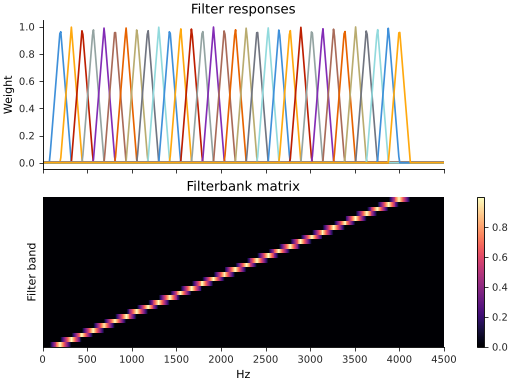
Construct a triangular filterbank mapping FFT bins onto linearly spaced bands:
>>> sr, n_fft = 22050, 2048
>>> f_in = librosa.fft_frequencies(sr=sr, n_fft=n_fft)
>>> f_out = np.linspace(200, 4000, 32)
>>> fb = librosa.filters.frequency_filterbank(f_in, f_out, window="triangle")
>>> fb.shape
(32, 1025)
Construct a logarithmic boxcar filterbank (exact energy pooling):
>>> f_pitches = librosa.midi_to_hz(np.arange(21, 109))
>>> fb_pitch = librosa.filters.frequency_filterbank(
...     f_in, f_pitches, window="boxcar", scale="log"
... )
>>> fb_pitch.shape
(88, 1025)
>>> import matplotlib.pyplot as plt
>>> fig, ax = plt.subplots(nrows=2, sharex=True)
>>> ax[0].plot(f_in, fb.T)
>>> ax[0].set(xlim=[0, 4500], ylabel="Weight", title="Filter responses")
>>> img = librosa.display.specshow(fb, x_coords=f_in, x_axis="linear", ax=ax[1])
>>> ax[1].set(ylabel="Filter band", title="Filterbank matrix")
>>> fig.colorbar(img, ax=ax[1])