
librosa.decompose.pitch_basis#
- librosa.decompose.pitch_basis(*, sr=None, n_fft=None, freq_in=None, n_pitches=84, fmin=None, intervals='equal', bins_per_octave=12, tuning=0.0, window='triangle', harmonics=None, harmonic_weights=None, offset=0.0001, n_residual=5, residual=None, norm=2, dtype=<class 'numpy.float32'>)[source]#
Construct a pitch template basis matrix for decomposition.
Produces a non-negative spectral basis matrix suitable for initializing or constraining non-negative matrix factorization (NMF) or other dictionary-based decompositions.
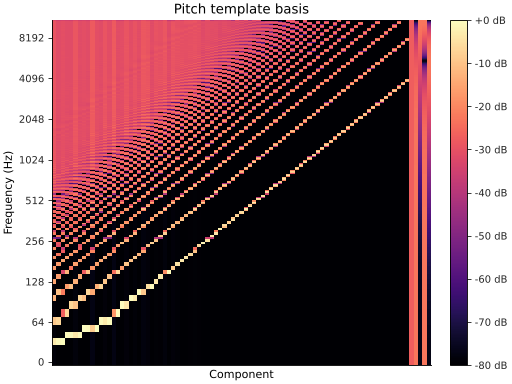
By default, pitch templates model a harmonic comb decaying as \(1/m\), supplemented by 5 non-negative Discrete Cosine Transform (DCT) residual templates (broadband, low shelf, high shelf, mid-scoop, and mid-hump) to capture transients and unpitched noise.
- Parameters:
- srnumber > 0 [scalar, optional]
Audio sampling rate. Required if
freq_inis not specified.- n_fftint > 0 [scalar, optional]
Length of the FFT frame. Required if
freq_inis not specified.- freq_innp.ndarray [shape=(n_in,)], optional
Coordinates of input frequency bins. If not provided, computed as
fft_frequencies(sr=sr, n_fft=n_fft).- n_pitchesint > 0 [scalar], default=84
Number of pitch bands to generate. Default 84 covers 7 octaves.
- fminfloat > 0, str, or None, optional
Minimum pitch center frequency (or note name in SPN format, e.g. ‘C1’). If None, defaults to ‘C1’ (~32.7 Hz).
- intervalsstr or collection of float, default=’equal’
Tuning / interval system to use:
‘equal’: Equal temperament.
‘pythagorean’: Pythagorean intervals.
‘ji3’, ‘ji5’, ‘ji7’: 3-limit, 5-limit, or 7-limit Just Intonation.
Collection of floats in [1, 2): Custom interval set.
- bins_per_octaveint > 0 [scalar], default=12
Number of bins per octave in the interval system.
- tuningfloat [scalar], default=0.0
Tuning deviation from A440 in fractions of a bin.
- windowstr or callable, default=’triangle’
Filter shape for each pitch / harmonic peak: ‘triangle’, ‘boxcar’, ‘hann’, or ‘gaussian’.
- harmonicssequence of float, optional
Harmonics to include in each pitch template. If None, includes all harmonics up to Nyquist with \(1/m\) decay. Pass
harmonics=[1]for fundamental-only templates (transposed pitch filter).- harmonic_weightssequence of float, optional
Weights applied to each harmonic. If None, defaults to \(1.0 / m\).
- offsetfloat >= 0, default=1e-4
Small additive offset applied to all template entries to ensure strictly positive values, preventing multiplicative updates from freezing zero bins.
- n_residualint >= 0, default=5
Number of DCT-based residual templates to append for broadband transients/noise. Odd numbers (e.g., 1, 3, 5) produce symmetric shelf/hump pairs.
- residualnp.ndarray [shape=(n_in, n_residual)], optional
Pre-defined residual templates to append instead of the DCT basis.
- norm{None, number}, default=2
Column normalization applied to each basis template.
- dtypenp.dtype, default=np.float32
Data type of the output basis matrix.
- Returns:
- basisnp.ndarray [shape=(n_in, n_components)]
Non-negative basis matrix with
n_components = n_pitches + n_residual. Columns 0 ton_pitches - 1are the pitch templates. Columnsn_pitcheston_components - 1are the residual templates.
See also
pitch_filterbankfrequency_filterbanklibrosa.decompose.decomposelibrosa.decompose.pitch_nmf
Notes
This function caches at level 10.
Examples
Construct a pitch template basis covering 7 octaves with 5 residual templates:
>>> basis = librosa.filters.pitch_basis(sr=22050, n_fft=2048)
>>> basis.shape
(1025, 89)
Construct fundamental-only pitch templates without residual components:
>>> basis_fund = librosa.filters.pitch_basis(
...     sr=22050, n_fft=2048, harmonics=[1], n_residual=0
... )
>>> basis_fund.shape
(1025, 84)
Plot the basis templates:
>>> import matplotlib.pyplot as plt
>>> fig, ax = plt.subplots()
>>> img = librosa.display.specshow(
...     librosa.amplitude_to_db(basis, ref=np.max),
...     sr=22050,
...     n_fft=2048,
...     y_axis="log",
...     ax=ax,
... )
>>> ax.set(
...     xlabel="Component", ylabel="Frequency (Hz)", title="Pitch template basis"
... )
>>> fig.colorbar(img, ax=ax, format="%+2.0f dB")