
librosa.feature.pitch_spectrogram#
- librosa.feature.pitch_spectrogram(*, y=None, sr=22050, S=None, n_fft=2048, hop_length=512, win_length=None, window='hann', center=True, pad_mode='constant', power=2.0, tuning=0.0, n_pitches=128, fmin=None, intervals='equal', bins_per_octave=12, filter_window=None, norm=None, **kwargs)[source]#
Compute a musical pitch-anchored spectrogram.
Groups spectral energy from an STFT or input spectrogram into discrete musical pitch bands under specified intonation assumptions (e.g., equal temperament, Pythagorean, Just Intonation).
- Parameters:
- ynp.ndarray [shape=(…, n)]
Audio time-series. Multi-channel is supported.
- srnumber > 0 [scalar]
Sampling rate of
y.- Snp.ndarray [shape=(…, d, t)]
Pre-computed spectrogram.
- n_fftint > 0 [scalar]
Length of the FFT window.
- hop_lengthint > 0 [scalar]
Number of samples between successive frames.
- win_lengthint <= n_fft [scalar]
Window length for the STFT.
- windowstr, tuple, number, function, or np.ndarray [shape=(n_fft,)]
Window specification for the STFT.
- centerbool
If True, the input signal is padded so that frame
tis centered att * hop_length.- pad_modestr
Padding mode for the STFT.
- powerfloat > 0 [scalar]
Exponent for the magnitude spectrogram: e.g., 1 for energy, 2 for power, etc.
- tuningfloat [scalar] or None
Deviation (in fractions of a bin) from A440 tuning. If None and
intervals == 'equal', tuning is automatically estimated from the spectrogram.- n_pitchesint > 0 [scalar], default=128
Number of pitch bands to generate. Default 128 covers MIDI notes 0 to 127.
- fminfloat > 0, str, or None, optional
Minimum pitch center frequency (or note name in SPN format, e.g. ‘C1’). If None, defaults to MIDI 0 (~8.18 Hz) when
n_pitches=128, or ‘C1’.- intervalsstr or collection of float, default=’equal’
Interval system to use:
‘equal’: Equal temperament.
‘pythagorean’: Pythagorean intervals.
‘ji3’, ‘ji5’, ‘ji7’: 3-limit, 5-limit, or 7-limit Just Intonation.
Collection of floats in [1, 2): Custom interval set.
- bins_per_octaveint > 0 [scalar], default=12
Number of bins per octave in the interval system.
- filter_windowstr, callable, or None, default=None
Filter shape for each pitch band. Default None (or ‘ones’) performs exact rectangular energy summation across semitone boundaries. Also supports ‘triangle’, ‘hann’, ‘gaussian’.
- norm{None, ‘slaney’, or number}, default=None
Normalization applied to each filter row.
- **kwargsadditional keyword arguments
Additional keyword arguments to
librosa.filters.pitch_filterbank.
- Returns:
- pitch_spectrogramnp.ndarray [shape=(…, n_pitches, t)]
Pitch spectrogram.
Examples
Compute a 128-pitch spectrogram with rectangular pooling (libfmp pool_pitch equivalent):
>>> y, sr = librosa.loadx("trumpet")
>>> S_pitch = librosa.feature.pitch_spectrogram(y=y, sr=sr)
>>> S_pitch.shape
(128, 230)
Compute a Just Intonation pitch spectrogram:
>>> S_ji = librosa.feature.pitch_spectrogram(
...     y=y, sr=sr, intervals="ji5", fmin="C1", n_pitches=84
... )
>>> S_ji.shape
(84, 230)
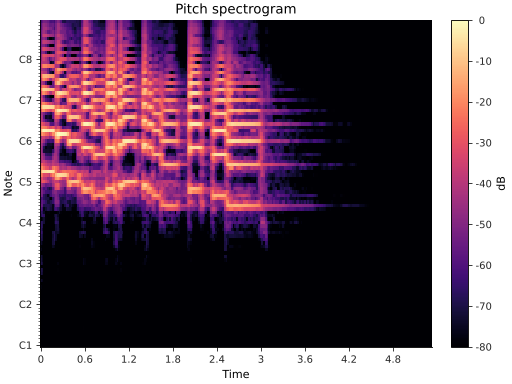
Display a 8-octave (C1-B8) pitch spectrogram using musical note names:
>>> S_p7 = librosa.feature.pitch_spectrogram(y=y, sr=sr, n_pitches=96, fmin="C1")
>>> import matplotlib.pyplot as plt
>>> fig, ax = plt.subplots()
>>> S_dB = librosa.power_to_db(S_p7, ref=np.max)
>>> img = librosa.display.specshow(
...     S_dB,
...     x_axis="time",
...     y_axis="pitch_note",
...     sr=sr,
...     fmin=librosa.note_to_hz("C1"),
...     ax=ax,
... )
>>> librosa.display.colorbar_db(img)
>>> ax.set(title="Pitch spectrogram")