
librosa.tone#
- librosa.tone(frequency, *, sr=22050, length=None, duration=None, phi=None, taper=False)[source]#
Construct a pure tone (cosine) signal at a given frequency.
- Parameters:
- frequencyfloat > 0 or str
frequency (in Hz) or note name in SPN format (e.g., ‘A4’)
- srnumber > 0
desired sampling rate of the output signal
- lengthint > 0
desired number of samples in the output signal. When both
durationandlengthare defined,lengthtakes priority.- durationfloat > 0
desired duration in seconds. When both
durationandlengthare defined,lengthtakes priority.- phifloat or None
phase offset, in radians. If unspecified, defaults to
-np.pi * 0.5.- taperbool
If
True, taper the edges of the signal with a cosine fade-in and fade-out of one period duration.
- Returns:
- tone_signalnp.ndarray [shape=(length,), dtype=float64]
Synthesized pure sine tone signal
- Raises:
- ParameterValueError
If
frequencyis not provided.If neither
lengthnordurationare provided.
Examples
Generate a pure sine tone A4
>>> tone = librosa.tone("A4", duration=1, sr=22050)
Or generate the same signal using length
>>> tone = librosa.tone("A4", sr=22050, length=22050)
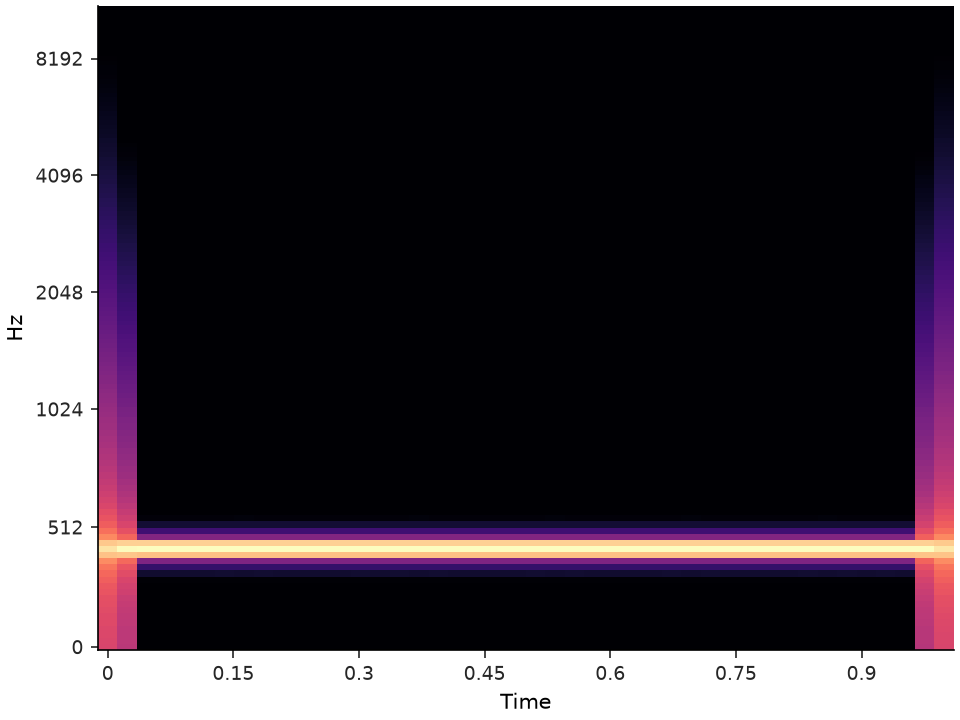
Display spectrogram
>>> import matplotlib.pyplot as plt
>>> fig, ax = plt.subplots()
>>> S = librosa.feature.melspectrogram(y=tone)
>>> librosa.display.specshow(
...     S, vscale="dBFS[power]", x_axis="time", y_axis="mel", ax=ax
... )