
librosa.griffinlim_cqt#
- librosa.griffinlim_cqt(C, *, n_iter=32, sr=22050, hop_length=512, fmin=None, bins_per_octave=12, tuning=0.0, filter_scale=1, norm=1, sparsity=0.01, window='hann', scale=True, pad_mode='constant', res_type='soxr_hq', dtype=None, length=None, momentum=0.99, init='random', rng=None, random_state=<DEPRECATED parameter>)[source]#
Approximate constant-Q magnitude spectrogram inversion using the “fast” Griffin-Lim algorithm.
Given the magnitude of a constant-Q spectrogram (
C), the algorithm randomly initializes phase estimates, and then alternates forward- and inverse-CQT operations. [1]This implementation is based on the (fast) Griffin-Lim method for Short-time Fourier Transforms, [2] but adapted for use with constant-Q spectrograms.
- Parameters:
- Cnp.ndarray [shape=(…, n_bins, n_frames)]
The constant-Q magnitude spectrogram
- n_iterint > 0
The number of iterations to run
- srnumber > 0
Audio sampling rate
- hop_lengthint > 0
The hop length of the CQT
- fminnumber > 0
Minimum frequency for the CQT.
If not provided, it defaults to C1.
- bins_per_octaveint > 0
Number of bins per octave
- tuningfloat
Tuning deviation from A440, in fractions of a bin
- filter_scalefloat > 0
Filter scale factor. Small values (<1) use shorter windows for improved time resolution.
- norm{inf, -inf, 0, float > 0}
Type of norm to use for basis function normalization. See
librosa.util.normalize.- sparsityfloat in [0, 1)
Sparsify the CQT basis by discarding up to
sparsityfraction of the energy in each basis.Set
sparsity=0to disable sparsification.- windowstr, tuple, or function
Window specification for the basis filters. See
filters.get_windowfor details.- scalebool
If
True, scale the CQT response by square-root the length of each channel’s filter. This is analogous tonorm='ortho'in FFT.If
False, do not scale the CQT. This is analogous tonorm=Nonein FFT.- pad_modestr
Padding mode for centered frame analysis.
See also:
librosa.stftandnumpy.pad.- res_typestr
The resampling mode for recursive downsampling.
See
librosa.resamplefor a list of available options.- dtypenumeric type
Real numeric type for
y. Default is inferred to match the precision of the input CQT.- lengthint > 0, optional
If provided, the output
yis zero-padded or clipped to exactlylengthsamples.- momentumfloat > 0
The momentum parameter for fast Griffin-Lim. Setting this to 0 recovers the original Griffin-Lim method. Values near 1 can lead to faster convergence, but above 1 may not converge.
- initNone or ‘random’ [default]
If ‘random’ (the default), then phase values are initialized randomly according to
random_state. This is recommended when the inputCis a magnitude spectrogram with no initial phase estimates.If
None, then the phase is initialized fromC. This is useful when an initial guess for phase can be provided, or when you want to resume Griffin-Lim from a previous output.- rngNone, int, sequence of int, np.random.Generator, or np.random.RandomState
Pseudorandom number generator state. When rng is None, a new
numpy.random.Generatoris created using entropy from the operating system. Types other thannumpy.random.Generatorare passed tonumpy.random.default_rngto instantiate aGenerator.- random_stateNone, int, np.random.RandomState, or np.random.Generator
Warning
This parameter is deprecated in 1.0.0 and will be removed in 1.2.0.
If int, random_state is the seed used by the random number generator for phase initialization.
If np.random.RandomState or np.random.Generator instance, the random number generator itself.
If
None, defaults to the np.random.default_rng() object.An exception is raised if both rng and random_state are provided.
- Returns:
- ynp.ndarray [shape=(…, n)]
time-domain signal reconstructed from
C
See also
Examples
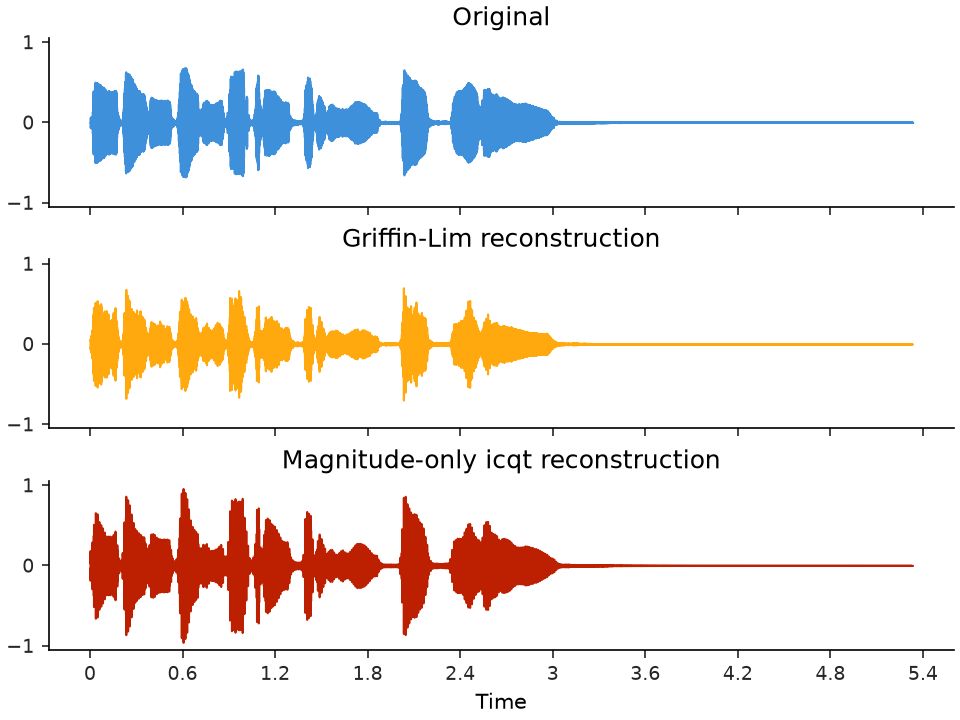
A basic CQT inverse example
>>> y, sr = librosa.loadx('trumpet', sr=None)
>>> # Get the CQT magnitude, 7 octaves at 36 bins per octave
>>> C = np.abs(librosa.cqt(y=y, sr=sr, bins_per_octave=36, n_bins=7*36))
>>> # Invert using Griffin-Lim
>>> y_inv = librosa.griffinlim_cqt(C, sr=sr, bins_per_octave=36)
>>> # And invert without estimating phase
>>> y_icqt = librosa.icqt(C, sr=sr, bins_per_octave=36)
Wave-plot the results
>>> import matplotlib.pyplot as plt
>>> fig, ax = plt.subplots(nrows=3, sharex=True, sharey=True)
>>> librosa.display.waveshow(y, sr=sr, color='C0', ax=ax[0])
>>> ax[0].set(title='Original', xlabel=None)
>>> ax[0].label_outer()
>>> librosa.display.waveshow(y_inv, sr=sr, color='C1', ax=ax[1])
>>> ax[1].set(title='Griffin-Lim reconstruction', xlabel=None)
>>> ax[1].label_outer()
>>> librosa.display.waveshow(y_icqt, sr=sr, color='C2', ax=ax[2])
>>> ax[2].set(title='Magnitude-only icqt reconstruction')