
librosa.segment.lag_to_recurrence#
- librosa.segment.lag_to_recurrence(lag, *, axis=-1)[source]#
Convert a lag matrix into a recurrence matrix.
- Parameters:
- lagnp.ndarray or scipy.sparse array
A lag matrix, as produced by
recurrence_to_lag- axisint
The axis corresponding to the time dimension. The alternate axis will be interpreted in lag coordinates.
- Returns:
- recnp.ndarray or scipy.sparse array [shape=(n, n)]
A recurrence matrix in (time, time) coordinates For sparse arrays, format will match that of
lag.
- Raises:
- ParameterShapeError
If
lagdoes not have the correct shape
See also
Examples
>>> y, sr = librosa.loadx("nutcracker")
>>> hop_length = 1024
>>> chroma = librosa.feature.chroma_cqt(y=y, sr=sr, hop_length=hop_length)
>>> chroma_stack = librosa.feature.stack_memory(chroma, n_steps=10, delay=3)
>>> recurrence = librosa.segment.recurrence_matrix(chroma_stack)
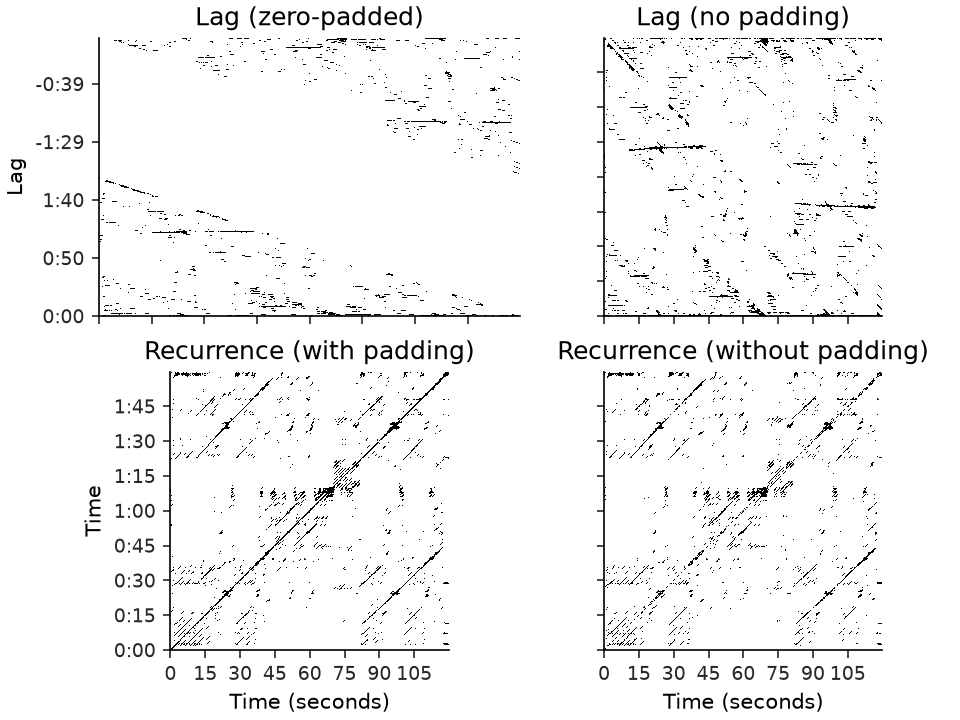
>>> lag_pad = librosa.segment.recurrence_to_lag(recurrence, pad=True)
>>> lag_nopad = librosa.segment.recurrence_to_lag(recurrence, pad=False)
>>> rec_pad = librosa.segment.lag_to_recurrence(lag_pad)
>>> rec_nopad = librosa.segment.lag_to_recurrence(lag_nopad)
>>> import matplotlib.pyplot as plt
>>> fig, ax = plt.subplots(nrows=2, ncols=2, sharex=True)
>>> librosa.display.specshow(
...     lag_pad, x_axis="s", y_axis="lag", hop_length=hop_length, ax=ax[0, 0]
... )
>>> ax[0, 0].set(title="Lag (zero-padded)")
>>> ax[0, 0].label_outer()
>>> librosa.display.specshow(
...     lag_nopad, x_axis="s", y_axis="time", hop_length=hop_length, ax=ax[0, 1]
... )
>>> ax[0, 1].set(title="Lag (no padding)")
>>> ax[0, 1].label_outer()
>>> librosa.display.specshow(
...     rec_pad, x_axis="s", y_axis="time", hop_length=hop_length, ax=ax[1, 0]
... )
>>> ax[1, 0].set(title="Recurrence (with padding)")
>>> librosa.display.specshow(
...     rec_nopad, x_axis="s", y_axis="time", hop_length=hop_length, ax=ax[1, 1]
... )
>>> ax[1, 1].set(title="Recurrence (without padding)")
>>> ax[1, 1].label_outer()