
librosa.onset.onset_backtrack#
- librosa.onset.onset_backtrack(events, energy)[source]#
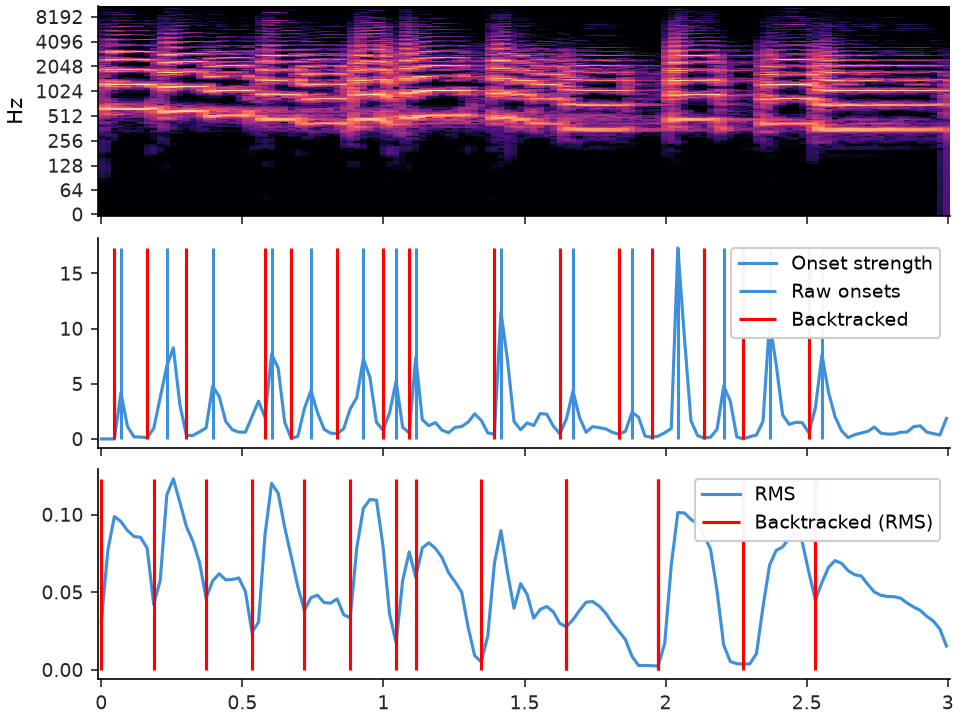
Backtrack detected onset events to the nearest preceding local minimum of an energy function.
This function can be used to roll back the timing of detected onsets from a detected peak amplitude to the preceding minimum.
This is most useful when using onsets to determine slice points for segmentation, as described by [1].
- Parameters:
- eventsnp.ndarray, dtype=int
List of onset event frame indices, as computed by
onset_detect- energynp.ndarray, shape=(m,)
An energy function
- Returns:
- events_backtrackednp.ndarray, shape=events.shape
The input events matched to nearest preceding minima of
energy.
Examples
Backtrack the events using the onset envelope
>>> y, sr = librosa.loadx("trumpet", duration=3)
>>> oenv = librosa.onset.onset_strength(y=y, sr=sr)
>>> times = librosa.times_like(oenv, sr=sr)
>>> # Detect events without backtracking
>>> onset_raw = librosa.onset.onset_detect(onset_envelope=oenv, backtrack=False)
>>> onset_bt = librosa.onset.onset_backtrack(onset_raw, oenv)
Backtrack the events using the RMS values
>>> S = np.abs(librosa.stft(y=y))
>>> rms = librosa.feature.rms(S=S)
>>> onset_bt_rms = librosa.onset.onset_backtrack(onset_raw, rms[0])
Plot the results
>>> import matplotlib.pyplot as plt
>>> fig, ax = plt.subplots(nrows=3, sharex=True)
>>> librosa.display.specshow(
...     S, vscale="dBFS", y_axis="log", x_axis="time", ax=ax[0]
... )
>>> ax[0].label_outer()
>>> ax[1].plot(times, oenv, label="Onset strength")
>>> ax[1].vlines(
...     librosa.frames_to_time(onset_raw), 0, oenv.max(), label="Raw onsets"
... )
>>> ax[1].vlines(
...     librosa.frames_to_time(onset_bt),
...     0,
...     oenv.max(),
...     label="Backtracked",
...     color="r",
... )
>>> ax[1].legend()
>>> ax[1].label_outer()
>>> ax[2].plot(times, rms[0], label="RMS")
>>> ax[2].vlines(
...     librosa.frames_to_time(onset_bt_rms),
...     0,
...     rms.max(),
...     label="Backtracked (RMS)",
...     color="r",
... )
>>> ax[2].legend()