
librosa.decompose.pitch_nmf#
- librosa.decompose.pitch_nmf(S, *, sr=22050, n_fft=None, freq_in=None, n_pitches=84, fmin=None, intervals='equal', bins_per_octave=12, tuning=0.0, window='triangle', harmonics=None, harmonic_weights=None, offset=0.0001, n_residual=5, residual=None, norm=2, fit=True, solver='mu', beta_loss='frobenius', max_iter=200, **kwargs)[source]#
Perform pitch-informed Non-negative Matrix Factorization (NMF).
This function constructs a pitch template basis matrix via
pitch_basisand applies Non-negative Matrix Factorization to decompose the input spectrogramS ~= components.dot(activations).By default, it uses multiplicative updates (
solver='mu') initialized with harmonic comb templates (decaying as \(1/m\)) and 5 DCT-based residual templates (broadband, low shelf, high shelf, mid-scoop, and mid-hump) to capture non-pitched transients and noise.- Parameters:
- Snp.ndarray [shape=(…, n_features, n_samples)]
Input spectrogram (e.g., magnitude spectrogram).
- srnumber > 0 [scalar], default=22050
Audio sampling rate.
- n_fftint > 0 [scalar, optional]
FFT window length. If not provided and
freq_inis not given, it is inferred fromS.shape[-2]as2 * (S.shape[-2] - 1).- freq_innp.ndarray, optional
Frequencies of the spectrogram rows.
- n_pitchesint > 0, default=84
Number of pitch bands to generate. Default 84 covers 7 octaves.
- fminfloat > 0, str, or None, optional
Minimum pitch center frequency (in Hz) or note name in SPN format (e.g. ‘C1’). Defaults to ‘C1’ (~32.7 Hz).
- intervalsstr or collection of float, default=’equal’
Interval system to use (‘equal’, ‘pythagorean’, ‘ji5’, etc.).
- bins_per_octaveint > 0, default=12
Number of bins per octave in the interval system.
- tuningfloat, default=0.0
Tuning deviation from A440 in fractions of a bin.
- windowstr or callable, default=’triangle’
Filter shape for each pitch / harmonic peak.
- harmonicssequence of float, optional
Harmonics to include in each pitch template. If None, includes all harmonics up to Nyquist with \(1/m\) decay. Pass
harmonics=[1]for fundamental-only templates.- harmonic_weightssequence of float, optional
Weights for each harmonic. If None, defaults to \(1/m\).
- offsetfloat >= 0, default=1e-4
Small additive offset applied to all template values to ensure well-posed multiplicative updates.
- n_residualint >= 0, default=5
Number of DCT-based residual templates (for broadband transients/noise). Odd numbers (e.g., 1, 3, 5) produce symmetric shelf/hump pairs.
- residualnp.ndarray, optional
Custom residual basis templates to append instead of DCT basis.
- norm{None, number}, default=2
Column normalization for basis templates.
- fitbool, default=True
If True, estimates components and activations via NMF starting from the pitch template basis. If False, uses the pitch template basis as fixed components and estimates only activations.
- solver{‘mu’, ‘cd’}, default=’mu’
NMF solver. Multiplicative updates (
'mu') is the standard in music audio decomposition.- beta_loss{‘frobenius’, ‘kullback-leibler’, ‘itakura-saito’} or float, default=’frobenius’
Beta divergence loss to minimize.
- max_iterint, default=200
Maximum number of iterations.
- **kwargsadditional keyword arguments
Additional arguments to
sklearn.decomposition.NMFordecompose.
- Returns:
- componentsnp.ndarray [shape=(…, n_features, n_components)]
Learned or fixed basis components, where
n_components = n_pitches + n_residual. Pitch components are incomponents[..., :n_pitches], and residual components are incomponents[..., n_pitches:].- activationsnp.ndarray [shape=(n_components, n_samples)]
Temporal activations for each component.
Notes
This function caches at level 30.
Examples
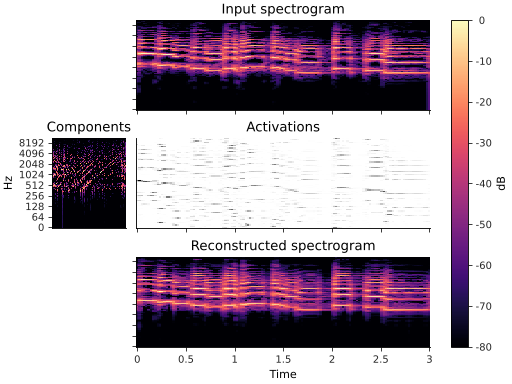
Decompose a trumpet spectrogram into pitch and residual components:
>>> y, sr = librosa.loadx("trumpet", duration=3)
>>> S = np.abs(librosa.stft(y))
>>> comps, acts = librosa.decompose.pitch_nmf(S, sr=sr, n_pitches=72, fmin="C2")
>>> import matplotlib.pyplot as plt
>>> layout = [list(".AAAA"), list("BCCCC"), list(".DDDD")]
>>> fig, ax = plt.subplot_mosaic(layout, constrained_layout=True)
>>> librosa.display.specshow(
...     S, vscale="dBFS", y_axis="log", x_axis="time", ax=ax["A"]
... )
>>> ax["A"].set(title="Input spectrogram")
>>> ax["A"].label_outer()
>>> librosa.display.specshow(comps, vscale="dBFS", y_axis="log", ax=ax["B"])
>>> ax["B"].set(title="Components")
>>> ax["B"].label_outer()
>>> ax["B"].sharey(ax["A"])
>>> librosa.display.specshow(acts, x_axis="time", ax=ax["C"], cmap="gray_r")
>>> ax["C"].set(ylabel="Components", title="Activations")
>>> ax["C"].sharex(ax["A"])
>>> ax["C"].label_outer()
>>> S_approx = comps.dot(acts)
>>> img = librosa.display.specshow(
...     S_approx, vscale="dBFS", y_axis="log", x_axis="time", ax=ax["D"]
... )
>>> ax["D"].set(title="Reconstructed spectrogram")
>>> ax["D"].sharex(ax["A"])
>>> ax["D"].sharey(ax["A"])
>>> ax["D"].label_outer()
>>> librosa.display.colorbar_db(img, ax=list(ax.values()))